Governance Model – General Principles for the AgriData Space.
The Governance Model of the AgriDataSpace Cyprus is designed in alignment with the Data Spaces Support Centre (DSSC) Blueprint, ensuring a federated, trustworthy and interoperable data sharing ecosystem. Compliant with EU and national legal frameworks and considering co-creation methods and stakeholder-driven design, the Governance Model’s approach integrates legal, organizational and technical aspects, reflecting the multi-dimensional nature of data spaces.
- Multi-Stakeholder Governance:
The governance model adopts a multi-stakeholder approach, inclusive and participatory, ensuring that the perspectives of farmers, industry, public authorities, research organizations and technology providers are represented. This collaborative structure will support balanced decision-making and ensure that the dataspace serves the needs of the entire agri-food ecosystem. Decision-making processes incorporate stakeholder input and ensure balanced representation.
- Legal Triggers and Compliance Mechanisms:
The Governance Model has acknowledged that the legal dimension of the AgriDataSpace.cy is a core design feature covering compliance, data governance and contractual agreements. Aiming to secure that the AgriDataSpace.cy operates within the relevant regulatory framework, it acknowledges the relevant legal triggers (types of data, types of participants and types of use cases) and protects the rights of all its stakeholders. Thus, it builds confidence in the dataspace ecosystem and ensures compliance with:
- Data-Related Legislation: For personal data (GDPR, e-privacy Directive), non-personal data (Implementing Act on High Value Datasets, Open Data Directive, Regulation of Free Flow of non-personal data), Artificial intelligence (AI Act, AI Liability Directive), sector-specific regulations governing European Data Spaces, relevant CY and GR national legislation, as well as the EU Strategy for Data, the Data Governance Act (DGA) and the Data Act (DA)
- Platform Regulations: The Digital Markets Act (DMA), the Digital Services Act (DSA) and the Platform-to-business relations (P2B Regulation)
- Intellectual Property Law: Including trade secrets, copyright, sui generis database right
- Competition Law: 101 TFEU, Art. 102 TFEU
- Trust & Security: Indicatively the eIDAS Regulation, NIS 2 DIRECTIVE, Cybersecurity Act
- Contract Law: Consumer Law, Unfair Commercial Practices, national CY and GR laws
- Ethical and Responsible Data Use:
Data sharing within AgriDataSpace.cy will follow principles of ethical use, responsible innovation and respect for stakeholders’ interests. Clear policies will ensure that data is used only for agreed purposes and in a manner that is fair, non-exploitative, transparent and respectful of users’ rights and expectations. All sensitive or personal data is appropriately protected. Ethical considerations are analyzed in the AgriDataSpace.cy Code of Conduct and the AgriDataSpace.cy Rulebook.
- Participation Management:
The governance framework will establish clear rules, policies, and non- discriminatory procedures for participation in the dataspace. All stakeholders, including farmers, cooperatives, businesses, technology providers, researchers and public authorities—will operate under transparent conditions that ensure provision of FAIR (Findable, Accessible, Interoperable and Reusable) services, access and equitable participation.
The AgriDataSpace.cy Rulebook will set the rules for the identification of participants, data transactions and service provision, onboarding and offboarding processes.
Relevant aspects from technical building block pillars including (non-exhaustive list)
- Trust and Data Sovereignty:
AgriDataSpaceCyprus ensures that its participants will maintain full control over their data, including the ability to define access conditions, usage rights and revoke permissions. Trust and data sovereignty is established through enforceable governance rules, transparent processes and secure technical infrastructures.
- (Intra/Cross Data Space) Interoperability and Open Standards:
AgriDataSpace.cy will promote the use of open, common data standards (ISO/IEC 38505, ISO/IEC 38500, ETSI, W3C), interoperable technologies and shared vocabulary. This will enable seamless data exchange between different systems and facilitate integration with broader European data space initiatives. This aligns with DSSC building blocks and supports compatibility with other European data spaces.
- Data Value Creation Enablers:
AgriDataSpace.cy promotes the creation of value from shared data for all the participants, supporting innovation and environmental sustainability, new digital services and improved decision-making in agriculture. At the same time, the governance model will aim to ensure the long-term viability of the dataspace ecosystem.
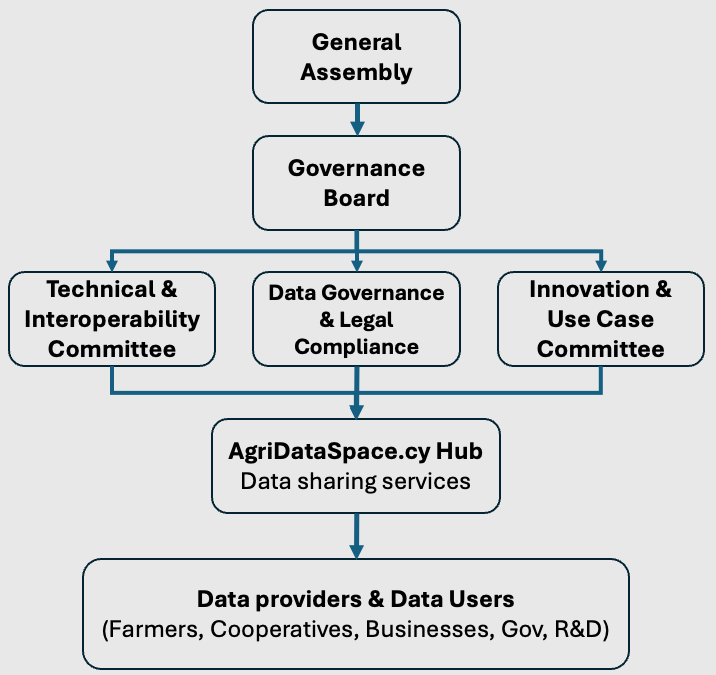
The Agridataspace.cy governance structure diagram
Governance Layers
At this stage the following Governance Layers are under specification.
- AgriDataSpaceCyprus Founding Agreement – creating special obligations towards its members regarding the achievement of the goals of their cooperation. The Governance Authority decided will govern the data space, will be responsible for managing the rulebook according to its governance rules and will continuously monitor the regulatory compliance of its data space
- AgriDataSpaceCyprus Rulebook – it describes all rules that participants of the data space must adhere to, as well as the underlying trust framework, onboarding processes including eligibility checks, contractual acceptance and accession agreements, role definitions and responsibilities of the participants, complaint handling and enforcement mechanisms
- AgriDataSpaceCyprus Data Sharing Agreements – between data space participant/member & data space participant/member, it regulates the relationship between the parties involved in data sharing
- AgriDataSpaceCyprus Service Agreements – between data space governance authority & service provider, it regulate the terms under which data space functionalities are provided
- AgriDataSpaceCyprus Code of Conduct - sets out the core principles, rules and responsibilities governing fair, transparent and secure data sharing within the data space, ensuring data sovereignty, ethical use and compliance with EU legal frameworks.